Context you may not know: besides building ZapVox, I'm a physician. This guide comes from real routine — patients send voice messages, and a patient's audio is not small talk: it carries symptoms, doses, adverse reactions, post-op questions. Clinical information that needs to become a record.
The problem: listening consumes time you don't have, and the content stays locked in a format that doesn't go into records, can't be searched and can't be copied.
The real cost of voice messages in clinical routine
Do the math on your week: 15 audios/day averaging 2 minutes is 30 minutes of daily listening — 2.5 hours a week. And listening isn't passive: it demands attention, often re-listening ("what dose did she say again?"), and frequently happens after hours.
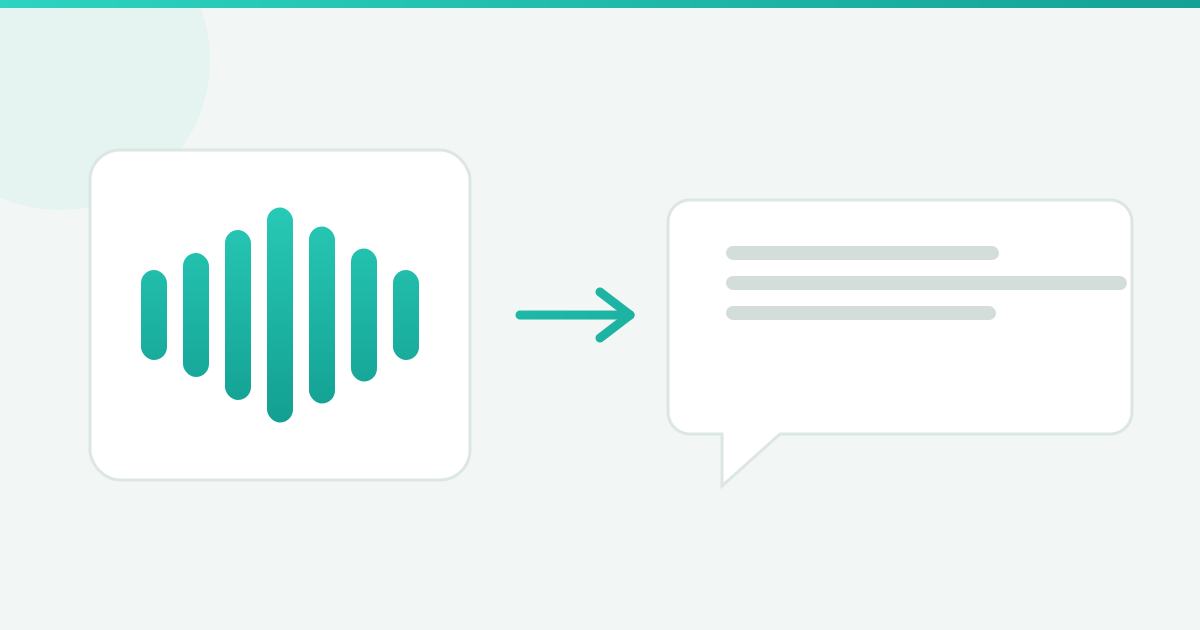
With automatic transcription, the same audio becomes text in seconds. You read a 2-minute audio in 20 seconds, scan for what's urgent and copy the relevant excerpt into the record.
The detail that separates "toy" from "tool": medical terms
Every generic transcriber trips on medical vocabulary. Real examples from practice:
- Tirzepatide → "terzepatyde", "tears a pat tide" (recent drug, the model doesn't know it);
- HbA1c → random spelled-out syllables;
- Dapagliflozin, semaglutide, rosuvastatin → creative variations in every audio;
- Test acronyms (TSH, PSA, ALT/AST) → spelled out or "corrected" into common words.
That's why ZapVox Pro has a custom glossary: you register the drugs, tests and terms of your daily practice once, and transcriptions start respecting them. For anyone using the text as record support, this changes everything — a wrong medication name in a clinical record is not a detail.
Practical flow: from patient audio to the record
- Audio arrives on WhatsApp Web (the clinic's or yours);
- Automatic or one-click transcription — the text appears next to the audio, in seconds;
- Quick review — transcription is support, not a substitute for clinical judgment: check doses and names before recording;
- Copy to the record — the patient's report in their own words, dated, no retyping;
- Need to find it later? Audio search finds any term across the last 90 days of transcriptions ("who mentioned fever this week?");
- End of day: the daily digest compiles what arrived as audio — a triage of what's still unanswered.
Privacy: what the clinic needs to verify
Patient audio contains sensitive health data (under Brazil's LGPD and similar frameworks). Before adopting any transcription tool, verify:
- Audio disposal: the audio should be processed and discarded, not stored indefinitely. In ZapVox, audio is discarded after processing;
- No model training on your data: confirm it in the privacy policy;
- Local transcriptions: in ZapVox, the searchable history lives in your browser, expiring after 7 days;
- BYOK option: for full control, use your own API key (Groq/OpenAI) — the audio goes straight from your browser to the provider YOU contracted;
- Clear roles: the clinic remains the data controller; the tool is a processor. Document this in your privacy governance.
And one rule no tool replaces: train your team on what can and cannot travel through WhatsApp according to the clinic's policy and your medical board's telemedicine rules.
Use cases beyond the consultation
- Front desk: patient audios asking to reschedule become text that goes straight into the scheduling system;
- Post-op: voice reports of recovery get recorded as dated text;
- Multidisciplinary teams: the nutritionist reads in 15 seconds the audio the patient sent to the endocrinologist;
- Foreign-language audios: international patient? Automatic translation handles it instantly (99+ languages).
What it costs (and what it gives back)
ZapVox Pro costs R$29.90 /month (or R$229.90 /year). If transcription saves the ~2.5 weekly hours from the math above, that's ~10 hours/month — run the numbers with the value of YOUR clinical hour. It's probably the cheapest software in the clinic per hour returned.
And you can start without paying: the Free plan includes 8 transcriptions/day, no credit card.
Try it on today's shift: 10 free transcriptions/day, no credit card.
Frequently asked questions
Is it safe to transcribe patient audios with AI?
With the right tool, yes: audio discarded after processing, privacy-compliant policy, no training on your data, and a BYOK option for full control. Choosing the processor well is the clinic's (controller's) responsibility.
Does transcription get medication names right?
Generic ones often don't. ZapVox Pro's custom glossary solves it: register your drugs and acronyms once.
Can I use transcriptions in patient records?
As support, yes — reviewing first, like any dictation. The gain is having the patient's report as copyable text in seconds.
A question specific to your clinic's workflow? Email [email protected] — the person answering understands medical practice.